Darshan Shashtra There are six Darshan Shashtras - also known as Upaang or Shat Darshan (The Six Visualisation); they are:-
Purva Mimaansa / Mimaansa Shashtra by Rishi Jaimini:- The author of this Darshan is Rishi Jaimini ji. The science of morals is discussed in detail. The concept of this darshan is Dharma, Dharmi (the thing which possess dharma) & Yagya (Sacrifice) & the duties & non-duties of the mankind which range from family life to national service are described, through which the extreme development of the entire nation is possible. Infect the great form of the Dharma is the Yagya (Sacrifice).
Vaisheshika Shashtra by Rishi Kannaad:- The author of this Darshan is Rishi Kanaad ji. He has described the true form of the Dharma. The mean that is helpful in achieving worldly & spiritual success is Dharma. Moksha ( Supreme Bliss) is obtained by living as truly righteous life & thereby getting the soul purified & exalted, and gaining a true conception of the six entities, viz., Noumenom, Attribute, Action, Commonness, Dissimilitude & Inherent relation, ( as of cause & effect, of whole with its parts). Its main themes are "Nothing can be created without any material', "Absence of the cause is absence of the effect", etc.
Nyaaya Shashtra by Rishi Gautam:- The author of this Darshan is Rishi Gautama ji. The subject of this darshan is to attain Moksha (Salvation) by getting the philosophical knowledge of 16 (sixteen) objects like Proof/Evidence, Proposition, Logic etc., The order in which the above 16 objects explained is as follows (i) Name (ii) Features & (iii) Detailed examination of the objects. Its main theme is " To examine the things through the proofs & evidences is Nyaaya". God is the creator of the universe, formless, omnipresent, Soul is different from the body, mind etc., & material nature is unintellect & raw material of the universe are clearly explained & proving the Traitavaad. An ancient & authentic commentary on this darshan by Maharishi Vaatsyayan ji is available.
Yoga Shashtra by Rishi Patanjali:- The author of this Darshan is Maharishi Patanjali ji & it deals with the Saadhana, Dhyan, Samaadhi etc., & gives a clear-cut idea about the God, Soul & Material world, true form of the God, Vedic worship (Upaasanaa) & Means of obtaining the Moksha (Salvation). Further subtle topics are also explained like, (i) what is yoga ?, (ii) What is the reason of soul's bondage ?, (iii) what are the different stages & attainments of the yoga practitioner (Saadhak) ?, (iv) what are the fluctuations of the mind & how to completely stop it ?, (v) Till what time the connection of the soul & mind exists? etc., An ancient & authentic commentary on this darshan by Maharishi Vyaasa ji's is very familiar in yoga.
Sankhya Shashtra by Rishi Kapil:- The author of this Darshan is Rishi Kapil ji & its subject is about the Prakriti & its products & Purusha. It is absorbed that the word "Purusha" is denoted for both the God & the Soul. The basis of this darshan is Sat Kaarya Vaad "Nothing can ever become something , nor can something ever become nothing". The order of Creation & Dissolution of the universe from the Prakriti is exclusively explained in this darshan. Only through discrimination obtained by knowing the true form of the material world & purusha, Moksha/Salvation is obtained. It is also explained that the universe is not false, True in existence by having the material world as the subtle cause & further 24 (Twenty Four) intermediate entities.
Uttar Mimaansa / Vedaant Shashtra by Rishi Veda Vyaas / Baadaraayana:- The author of this Darshan is Rishi Vyaasa ji & the subject is about the Brahmaa (Iswhar) & attainment of Brahmaa / Moksha (Salvation). Its other names are Brahmasootra & Uttar Meemaamsaa. Brahmaa (God) is an entity, which is omnipotent, omnipresent, blissful. He is free from sorrows of birth & death. Jeevaatmaa (Soul) is also a different entity having little intellect & subtle. He wants to get rid out of sorrows. God creates the universe from the Prakriti. The meaning of the Vedaanta is - "The essence of the Vedas".
In short some few common principles of the six Darshans :
By the freedom, from the three types of sorrows, Moksha (Salvation) is obtained.
God, Soul & Prakriti are the eternal causes of the creation of the universe.
Nonexistence of Existent objects & existence of nonexistent objects is extremely impossible.
Vedas are self-proven, because it is gospel-word of the God.
Soul is different from the body,mind etc., & inconsequential.
God is different from the soul, omnipresent, infinite intellect, omnipotent etc.,
According to the God's discipline & deeds done by the soul, the soul repeal the results of the deeds.
The visible universe is the product of the Prakriti.
The reason of the bondage of the soul is its ignorance.
Each & Every body has its own unique soul.
Soul can never become a God, it has its own unique existence.
Friday, 6 January 2012

HISTORY OF HINDUISM
Main article: History of Hinduism
Sacred Mount Kailash in Tibet is regarded as the spiritual abode of Lord Shiva.
The so-called Shiva Pashupati seal
Navy shoulderboard for Hindu military chaplain, South African military
The earliest evidence for prehistoric religion in India date back to the late Neolithic in the early Harappan period (5500–2600 BCE).[24][25] The beliefs and practices of the pre-classical era (1500–500 BCE) are called the "historical Vedic religion". The Vedic religion shows influence by Proto-Indo-European religion. Modern Hinduism grew out of the Vedas, the oldest of which is the Rigveda, dated to 1700–1100 BCE.[26] The Vedas center on worship of deities such as Indra, Varuna and Agni, and on the Soma ritual. Fire-sacrifices, called yajña were performed, and Vedic mantras chanted but no temples or idols are known.[27]
The major Sanskrit epics, Ramayana and Mahabharata, were compiled over a protracted period during the late centuries BCE and the early centuries CE.[28] They contain mythological stories about the rulers and wars of ancient India, and are interspersed with religious and philosophical treatises. The later Puranas recount tales about devas and devis, their interactions with humans and their battles against rakshasa.
Three major movements underpinned the naissance of a new epoch of Hindu thought: the advent and spread of Upanishadic, Jaina, and Buddhist philosophico-religious thought throughout the broader Indian landmass.[29] Mahavira (24th Tirthankara of Jainism) and Gautama Buddha (founder of Buddhism) taught that to achieve moksha or nirvana, one did not have to accept the authority of the Vedas or the caste system. Buddha went a step further and claimed that the existence of a Self/soul or God was unnecessary.[30] Buddhism peaked during the reign of Asoka the Great of the Mauryan Empire, who unified the Indian subcontinent in the 3rd century BCE. After 200 CE several schools of thought were formally codified in Indian philosophy, including Samkhya, Yoga, Nyaya, Vaisheshika, Purva-Mimamsa and Vedanta.[31] Charvaka, the founder of an atheistic materialist school, came to the fore in North India in the sixth century BCE.[32]
Sanskritic culture went into decline after the end of the Gupta period. The early medieval Puranas helped establish a religious mainstream among the pre-literate tribal societies undergoing acculturation. The tenets of Brahmanic Hinduism and of the Dharmashastras underwent a radical transformation at the hands of the Purana composers, resulting in the rise of a mainstream "Hinduism" that overshadowed all earlier traditions.[33]
Though Islam came to India in the early 7th century with the advent of Arab traders and the conquest of Sindh, it started to become a major religion during the later Muslim conquest in the Indian subcontinent.[32] During this period Buddhism declined rapidly and many Hindus were forcibly converted to Islam.[34][35][36] Numerous Muslim rulers or their army generals such as Aurangzeb and Malik Kafur destroyed Hindu temples[37][38][39] and persecuted non-Muslims; however some, such as Akbar, were more tolerant. Hinduism underwent profound changes, in large part due to the influence of the prominent teachers Ramanuja, Madhva, and Chaitanya.[32] Followers of the Bhakti movement moved away from the abstract concept of Brahman, which the philosopher Adi Shankara consolidated a few centuries before, with emotional, passionate devotion towards the more accessible Avatars, especially Krishna and Rama.[40]
The oldest Vedic traditions exhibit strong similarities to the pre-Zoroastrian Proto-Indo-Iranian religion and other Indo-European religions. For example, the Ṛgvedic deity Dyaus, regarded as the father of the other deities, is linguistically cognate with Zeus—the king of the gods in Greek mythology, Iovis (gen. of Jupiter) —the king of the gods in Roman mythology, and Tiu/Ziu in Germanic mythology. Other Vedic deities also have cognates with those found in other Indo-European speaking peoples' mythologies; see Proto-Indo-European religion and Comparison of Greek and Hindu Gods.[41]
Indology as an academic discipline of studying Indian culture from a European perspective was established in the 19th century, led by scholars such as Max Müller and John Woodroffe. They brought Vedic, Puranic and Tantric literature and philosophy to Europe and the United States. At the same time, societies such as the Brahmo Samaj and the Theosophical Society attempted to reconcile and fuse Abrahamic and Dharmic philosophies, endeavouring to institute societal reform. This period saw the emergence of movements which, while highly innovative, were rooted in indigenous tradition. They were based on the personalities and teachings of individuals, as with Ramakrishna and Ramana Maharshi. Prominent Hindu philosophers, including Aurobindo and Prabhupada (founder of ISKCON), translated, reformulated and presented Hinduism's foundational texts for contemporary audiences in new iterations, attracting followers and attention in India and abroad. Others such as Vivekananda, Paramahansa Yogananda, B.K.S. Iyengar and Swami Rama have also been instrumental in raising the profiles of Yoga and Vedanta in the West.
Sacred Mount Kailash in Tibet is regarded as the spiritual abode of Lord Shiva.
The so-called Shiva Pashupati seal
Navy shoulderboard for Hindu military chaplain, South African military
The earliest evidence for prehistoric religion in India date back to the late Neolithic in the early Harappan period (5500–2600 BCE).[24][25] The beliefs and practices of the pre-classical era (1500–500 BCE) are called the "historical Vedic religion". The Vedic religion shows influence by Proto-Indo-European religion. Modern Hinduism grew out of the Vedas, the oldest of which is the Rigveda, dated to 1700–1100 BCE.[26] The Vedas center on worship of deities such as Indra, Varuna and Agni, and on the Soma ritual. Fire-sacrifices, called yajña were performed, and Vedic mantras chanted but no temples or idols are known.[27]
The major Sanskrit epics, Ramayana and Mahabharata, were compiled over a protracted period during the late centuries BCE and the early centuries CE.[28] They contain mythological stories about the rulers and wars of ancient India, and are interspersed with religious and philosophical treatises. The later Puranas recount tales about devas and devis, their interactions with humans and their battles against rakshasa.
Three major movements underpinned the naissance of a new epoch of Hindu thought: the advent and spread of Upanishadic, Jaina, and Buddhist philosophico-religious thought throughout the broader Indian landmass.[29] Mahavira (24th Tirthankara of Jainism) and Gautama Buddha (founder of Buddhism) taught that to achieve moksha or nirvana, one did not have to accept the authority of the Vedas or the caste system. Buddha went a step further and claimed that the existence of a Self/soul or God was unnecessary.[30] Buddhism peaked during the reign of Asoka the Great of the Mauryan Empire, who unified the Indian subcontinent in the 3rd century BCE. After 200 CE several schools of thought were formally codified in Indian philosophy, including Samkhya, Yoga, Nyaya, Vaisheshika, Purva-Mimamsa and Vedanta.[31] Charvaka, the founder of an atheistic materialist school, came to the fore in North India in the sixth century BCE.[32]
Sanskritic culture went into decline after the end of the Gupta period. The early medieval Puranas helped establish a religious mainstream among the pre-literate tribal societies undergoing acculturation. The tenets of Brahmanic Hinduism and of the Dharmashastras underwent a radical transformation at the hands of the Purana composers, resulting in the rise of a mainstream "Hinduism" that overshadowed all earlier traditions.[33]
Though Islam came to India in the early 7th century with the advent of Arab traders and the conquest of Sindh, it started to become a major religion during the later Muslim conquest in the Indian subcontinent.[32] During this period Buddhism declined rapidly and many Hindus were forcibly converted to Islam.[34][35][36] Numerous Muslim rulers or their army generals such as Aurangzeb and Malik Kafur destroyed Hindu temples[37][38][39] and persecuted non-Muslims; however some, such as Akbar, were more tolerant. Hinduism underwent profound changes, in large part due to the influence of the prominent teachers Ramanuja, Madhva, and Chaitanya.[32] Followers of the Bhakti movement moved away from the abstract concept of Brahman, which the philosopher Adi Shankara consolidated a few centuries before, with emotional, passionate devotion towards the more accessible Avatars, especially Krishna and Rama.[40]
The oldest Vedic traditions exhibit strong similarities to the pre-Zoroastrian Proto-Indo-Iranian religion and other Indo-European religions. For example, the Ṛgvedic deity Dyaus, regarded as the father of the other deities, is linguistically cognate with Zeus—the king of the gods in Greek mythology, Iovis (gen. of Jupiter) —the king of the gods in Roman mythology, and Tiu/Ziu in Germanic mythology. Other Vedic deities also have cognates with those found in other Indo-European speaking peoples' mythologies; see Proto-Indo-European religion and Comparison of Greek and Hindu Gods.[41]
Indology as an academic discipline of studying Indian culture from a European perspective was established in the 19th century, led by scholars such as Max Müller and John Woodroffe. They brought Vedic, Puranic and Tantric literature and philosophy to Europe and the United States. At the same time, societies such as the Brahmo Samaj and the Theosophical Society attempted to reconcile and fuse Abrahamic and Dharmic philosophies, endeavouring to institute societal reform. This period saw the emergence of movements which, while highly innovative, were rooted in indigenous tradition. They were based on the personalities and teachings of individuals, as with Ramakrishna and Ramana Maharshi. Prominent Hindu philosophers, including Aurobindo and Prabhupada (founder of ISKCON), translated, reformulated and presented Hinduism's foundational texts for contemporary audiences in new iterations, attracting followers and attention in India and abroad. Others such as Vivekananda, Paramahansa Yogananda, B.K.S. Iyengar and Swami Rama have also been instrumental in raising the profiles of Yoga and Vedanta in the West.
രാമായണം
രാമായണം
ഭാരതത്തിന്റെ സംഭാവനയായ രണ്ട് ഇതിഹാസങ്ങളിൽ ഒന്നാണ് രാമായണം .[1]ഇംഗ്ലീഷ്:Ramayana. രാമന്റെ യാത്ര എന്നാണ് രാമായണത്തിനർത്ഥം. വാല്മീകി മഹർഷി രചിച്ച രാമായണം കാവ്യരൂപത്തിലുള്ള ആദ്യ കൃതിയാണ് എന്ന് വിശ്വസിക്കപ്പെടുന്നു. അതുകൊണ്ട് ഇത് ആദിമകാവ്യം എന്നും അറിയപ്പെടുന്നു. മഹത്തായ സീതാചരിത്രവും പൗലസ്ത്യവധവുമാണ് രാമകഥാസംക്ഷേപസാരം. ധാർമ്മികമൂല്യങ്ങളെ മുറുകെ പിടിക്കാനായി മഹത്തായ സിംഹാസനം വരെ ഉപേക്ഷിച്ച രാമനേയും ഭരതനേയും പോലുള്ള മനുഷ്യരുടെ കഥയിലൂടെ മഹത്തരമായ ധർമ്മസംരക്ഷണത്തെക്കുറിച്ചുള്ള സന്ദേശമാണ് വാൽമീകീ രാമായണത്തിൽ നിന്ന് ലഭിക്കുന്നത്. വാൽമീകീ രാമായണത്തിനു മുന്നേ തന്നെ രാമകഥയെ അടിസ്ഥാനമാക്കിയുള്ള ആഖ്യാനങ്ങൾ പ്രചാരത്തിലുണ്ടായിരുന്നു. ആ ആഖ്യാനങ്ങൾ ലഭ്യമല്ലാത്തതിനാലാണ് വാൽമീകി രാമായണം രാമകഥയുടെ ഏറ്റവും പ്രാചീനമായ രൂപമായിത്തീർന്നത്. [2]
പുരാതന ഭാരതത്തിലെ ഏറ്റവും പ്രധാനപ്പെട്ട സാഹിത്യ സൃഷ്ടികളിലൊന്നായ രാമായണത്തിന്റെ പ്രഭാവം ഇന്ത്യൻ ഉപഭൂഖണ്ഡത്തിലെയും ദക്ഷിണപൂർവേഷ്യയിലെയും സംസ്കാരങ്ങളിൽ പ്രതിഫലിച്ചുകാണാം. ഇന്ന് കാണുന്ന രാമായണം നിരവധി പ്രക്ഷിപ്തഭാഗങ്ങൾ ചേർന്നതാണ്. രാമനെ വെറുമൊരു സാധാരണ മനുഷ്യനായി വിവരിക്കുന്ന ആദ്യരൂപത്തോട് വിഷ്ണുവിന്റെ അവതാരങ്ങളിലൊന്നായി വാഴ്ത്തുന്ന തരത്തിലുള്ള ഭാഗങ്ങൾ പിന്നീട് ചേർക്കപ്പെട്ടതാണ് എന്ന വാദമുണ്ട്. രാമനെ ഈശ്വരനായി വാഴ്ത്തുന്ന സന്ദർഭങ്ങൾ എല്ലാം തന്നെ പിന്നീട് ചേർക്കപ്പെട്ടതാണെന്നും വാദിക്കപ്പെടുന്നു.[3], [4] [5] രാമായണത്തിൽ രാമനെ ഈശ്വരനായി ഉദ്ഘോഷിക്കുന്ന സന്ദർഭങ്ങൾ കൂടുതലും കാണുന്നത് ബാലകാണ്ഡത്തിലും ഉത്തരകാണ്ഡത്തിലും ആണ്. ഈ രണ്ടുകാണ്ഡങ്ങളും രാമായണത്തോട് പിൽക്കാലത്ത് കൂട്ടിചേർക്കപ്പെട്ടതാണെന്ന് പല പണ്ഡിതന്മാരും കാര്യകാരണ സഹിതം തെളിയിച്ചു കഴിഞ്ഞു. ഉത്തരകാണ്ഡത്തിന്റേയും ബാലകാണ്ഡത്തിന്റേയും രചനാശൈലി രാമായണത്തിന്റെ പ്രാമാണിക കാണ്ഡത്തിൽ നിന്ന് വളരെ വ്യത്യസ്തമായിരിക്കുന്നതും തന്ന ഇതിനുള്ള തെളിവാണ്. പല ഗ്രന്ഥകർത്താക്കളും തങ്ങളുടെ കൃതികളിൽ ഉത്തരകാണ്ഡത്തെ ഉൾക്കൊള്ളിച്ചിട്ടുമില്ല.
രാമായണം ബൗദ്ധകൃതിയെ അടിസ്ഥാനപ്പെടുത്തിയതാണെന്നും; ക്രി.മു. മൂന്നാം ശതകത്തിൽ എഴുതപ്പെട്ട ദശരഥജാതകത്തിലെ സ്രോതസ്സായ രാമകഥയാണ് (ഇത് വളരെക്കാലം മുൻപേ വായ്മൊഴിയാ പ്രചരിച്ചിരുന്നു) രാമായണത്തിനടിസ്ഥാനം എന്നും ചില ചരിത്രകാരന്മാർ വാദിക്കുന്നു. [6] [7]
ഭാരതത്തിന്റെ സംഭാവനയായ രണ്ട് ഇതിഹാസങ്ങളിൽ ഒന്നാണ് രാമായണം .[1]ഇംഗ്ലീഷ്:Ramayana. രാമന്റെ യാത്ര എന്നാണ് രാമായണത്തിനർത്ഥം. വാല്മീകി മഹർഷി രചിച്ച രാമായണം കാവ്യരൂപത്തിലുള്ള ആദ്യ കൃതിയാണ് എന്ന് വിശ്വസിക്കപ്പെടുന്നു. അതുകൊണ്ട് ഇത് ആദിമകാവ്യം എന്നും അറിയപ്പെടുന്നു. മഹത്തായ സീതാചരിത്രവും പൗലസ്ത്യവധവുമാണ് രാമകഥാസംക്ഷേപസാരം. ധാർമ്മികമൂല്യങ്ങളെ മുറുകെ പിടിക്കാനായി മഹത്തായ സിംഹാസനം വരെ ഉപേക്ഷിച്ച രാമനേയും ഭരതനേയും പോലുള്ള മനുഷ്യരുടെ കഥയിലൂടെ മഹത്തരമായ ധർമ്മസംരക്ഷണത്തെക്കുറിച്ചുള്ള സന്ദേശമാണ് വാൽമീകീ രാമായണത്തിൽ നിന്ന് ലഭിക്കുന്നത്. വാൽമീകീ രാമായണത്തിനു മുന്നേ തന്നെ രാമകഥയെ അടിസ്ഥാനമാക്കിയുള്ള ആഖ്യാനങ്ങൾ പ്രചാരത്തിലുണ്ടായിരുന്നു. ആ ആഖ്യാനങ്ങൾ ലഭ്യമല്ലാത്തതിനാലാണ് വാൽമീകി രാമായണം രാമകഥയുടെ ഏറ്റവും പ്രാചീനമായ രൂപമായിത്തീർന്നത്. [2]
പുരാതന ഭാരതത്തിലെ ഏറ്റവും പ്രധാനപ്പെട്ട സാഹിത്യ സൃഷ്ടികളിലൊന്നായ രാമായണത്തിന്റെ പ്രഭാവം ഇന്ത്യൻ ഉപഭൂഖണ്ഡത്തിലെയും ദക്ഷിണപൂർവേഷ്യയിലെയും സംസ്കാരങ്ങളിൽ പ്രതിഫലിച്ചുകാണാം. ഇന്ന് കാണുന്ന രാമായണം നിരവധി പ്രക്ഷിപ്തഭാഗങ്ങൾ ചേർന്നതാണ്. രാമനെ വെറുമൊരു സാധാരണ മനുഷ്യനായി വിവരിക്കുന്ന ആദ്യരൂപത്തോട് വിഷ്ണുവിന്റെ അവതാരങ്ങളിലൊന്നായി വാഴ്ത്തുന്ന തരത്തിലുള്ള ഭാഗങ്ങൾ പിന്നീട് ചേർക്കപ്പെട്ടതാണ് എന്ന വാദമുണ്ട്. രാമനെ ഈശ്വരനായി വാഴ്ത്തുന്ന സന്ദർഭങ്ങൾ എല്ലാം തന്നെ പിന്നീട് ചേർക്കപ്പെട്ടതാണെന്നും വാദിക്കപ്പെടുന്നു.[3], [4] [5] രാമായണത്തിൽ രാമനെ ഈശ്വരനായി ഉദ്ഘോഷിക്കുന്ന സന്ദർഭങ്ങൾ കൂടുതലും കാണുന്നത് ബാലകാണ്ഡത്തിലും ഉത്തരകാണ്ഡത്തിലും ആണ്. ഈ രണ്ടുകാണ്ഡങ്ങളും രാമായണത്തോട് പിൽക്കാലത്ത് കൂട്ടിചേർക്കപ്പെട്ടതാണെന്ന് പല പണ്ഡിതന്മാരും കാര്യകാരണ സഹിതം തെളിയിച്ചു കഴിഞ്ഞു. ഉത്തരകാണ്ഡത്തിന്റേയും ബാലകാണ്ഡത്തിന്റേയും രചനാശൈലി രാമായണത്തിന്റെ പ്രാമാണിക കാണ്ഡത്തിൽ നിന്ന് വളരെ വ്യത്യസ്തമായിരിക്കുന്നതും തന്ന ഇതിനുള്ള തെളിവാണ്. പല ഗ്രന്ഥകർത്താക്കളും തങ്ങളുടെ കൃതികളിൽ ഉത്തരകാണ്ഡത്തെ ഉൾക്കൊള്ളിച്ചിട്ടുമില്ല.
രാമായണം ബൗദ്ധകൃതിയെ അടിസ്ഥാനപ്പെടുത്തിയതാണെന്നും; ക്രി.മു. മൂന്നാം ശതകത്തിൽ എഴുതപ്പെട്ട ദശരഥജാതകത്തിലെ സ്രോതസ്സായ രാമകഥയാണ് (ഇത് വളരെക്കാലം മുൻപേ വായ്മൊഴിയാ പ്രചരിച്ചിരുന്നു) രാമായണത്തിനടിസ്ഥാനം എന്നും ചില ചരിത്രകാരന്മാർ വാദിക്കുന്നു. [6] [7]

maha vishnu
ഭഗവാന് മഹാവിഷ്ണുവിന്റെ നാലു കരങ്ങളിലുള്ള ആയുധങ്ങളാണ് ശംഖം , ചക്രം , ഗദ , പദ്മം എന്നിവ.....
ശ്വേതവര്ണ്ണവും പ്രകാശമാനവുമായ"പാഞ്ചജന്യം" എന്ന ശംഖം ബ്രഹ്മവാചിയായ പ്രണവത്തിന്റെ സ്രോതസ്സാണ്....അതിന്റെ ശബ്ദം സൃഷ്ടിസ്ഥിതി സംഹാരകാരകരായബ്രഹ്മ വിഷ്ണു പരമേശ്വരന്മാരായ ും നാദരൂപിയായ വിഷ്ണുമായയായുംരൂപംകൊണ്ട് പ്രപഞ്ചത്തെ ആനന്ദിപ്പിക്കുന ്നു....
ആര്ക്കും ഒന്നിനും നിരോദിക്കാനും നിയന്ത്രിക്കാനു ം ആകാതെ നിയതമായ വേഗത്തോടെ ഭ്രമണം ചെയ്യുന്ന "സുദര്ശനം" നിശിതധാരങ്ങളായ 360 ധാരകളും 12 ആരക്കാലുകളും ഉള്ളതാണ്....ഭഗവ ാന്റെ ചൂണ്ടുവിരലിന്റെ അറ്റത്ത് സദാകറങ്ങുന്ന ഈ ആയുധം സര്വ്വസംഹാരിയാ ണ്....കാലമാണ് ഈ ആയുധം ...കാലം കേവല സത്യമാണ്.."കൌമോ ദകി" എന്നു പേരുള്ള ഗദയാണ് ഭഗവാന്റെ മൂന്നാമത്തെ ആയുധം...ധര്മ്മ ദേവതയായ ഭൂമിദേവിയെ അധര്മ്മത്തില് നിന്നും രക്ഷിക്കാനാണ് ഭഗവാന് ഈ ആയുധം ഉപയോഗിക്കുന്നത് .....സൌന്ദര്യ സാക്ഷാത്കാരമാണ് പദ്മം അഥവാതാമര...സൃഷ്ടി കര്ത്താവായ ബ്രഹ്മദേവന്റെ ഉത്പത്തി താമരയിലയാണ് ....
ഈ നാലു ആയുധങ്ങളും സത്യത്തിന്റെ വിവിധഭാവങ്ങളാണ് ...സനാതന സത്യമായ പ്രണവം , ഭൌതികസത്യമായ കാലം , ഭൂമിദേവിക്ക് ആഹ്ലാദം പകരുന്ന കൌമോദകി,സൌന്ദര്യത്തിന് റെ പ്രതിരൂപമായ പദ്മം എന്നീ ആയുധങ്ങള് കൊണ്ട് അധര്മ്മത്തെ എതിര്ത്തു തോല്പിക്കുന്നു ഭഗവാന് മഹാവിഷ്ണു ...!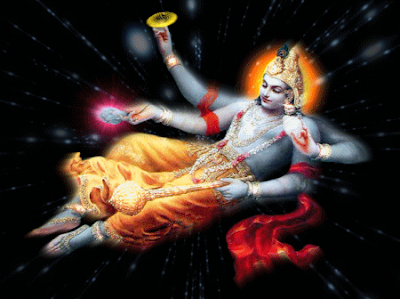
ശ്വേതവര്ണ്ണവും പ്രകാശമാനവുമായ"പാഞ്ചജന്യം" എന്ന ശംഖം ബ്രഹ്മവാചിയായ പ്രണവത്തിന്റെ സ്രോതസ്സാണ്....അതിന്റെ ശബ്ദം സൃഷ്ടിസ്ഥിതി സംഹാരകാരകരായബ്രഹ്മ വിഷ്ണു പരമേശ്വരന്മാരായ ും നാദരൂപിയായ വിഷ്ണുമായയായുംരൂപംകൊണ്ട് പ്രപഞ്ചത്തെ ആനന്ദിപ്പിക്കുന ്നു....
ആര്ക്കും ഒന്നിനും നിരോദിക്കാനും നിയന്ത്രിക്കാനു ം ആകാതെ നിയതമായ വേഗത്തോടെ ഭ്രമണം ചെയ്യുന്ന "സുദര്ശനം" നിശിതധാരങ്ങളായ 360 ധാരകളും 12 ആരക്കാലുകളും ഉള്ളതാണ്....ഭഗവ ാന്റെ ചൂണ്ടുവിരലിന്റെ അറ്റത്ത് സദാകറങ്ങുന്ന ഈ ആയുധം സര്വ്വസംഹാരിയാ ണ്....കാലമാണ് ഈ ആയുധം ...കാലം കേവല സത്യമാണ്.."കൌമോ ദകി" എന്നു പേരുള്ള ഗദയാണ് ഭഗവാന്റെ മൂന്നാമത്തെ ആയുധം...ധര്മ്മ ദേവതയായ ഭൂമിദേവിയെ അധര്മ്മത്തില് നിന്നും രക്ഷിക്കാനാണ് ഭഗവാന് ഈ ആയുധം ഉപയോഗിക്കുന്നത് .....സൌന്ദര്യ സാക്ഷാത്കാരമാണ് പദ്മം അഥവാതാമര...സൃഷ്ടി കര്ത്താവായ ബ്രഹ്മദേവന്റെ ഉത്പത്തി താമരയിലയാണ് ....
ഈ നാലു ആയുധങ്ങളും സത്യത്തിന്റെ വിവിധഭാവങ്ങളാണ് ...സനാതന സത്യമായ പ്രണവം , ഭൌതികസത്യമായ കാലം , ഭൂമിദേവിക്ക് ആഹ്ലാദം പകരുന്ന കൌമോദകി,സൌന്ദര്യത്തിന് റെ പ്രതിരൂപമായ പദ്മം എന്നീ ആയുധങ്ങള് കൊണ്ട് അധര്മ്മത്തെ എതിര്ത്തു തോല്പിക്കുന്നു ഭഗവാന് മഹാവിഷ്ണു ...!

history of balagokulam
History!
In 1950-s the seeds of Balagokulam were sown in the pages of ‘Kesari Weekly’ as a special column for children. In the early 1970-s Balagokulam units started in several places of Kerala. Shri, M.A. Krishnan, the then Chief Editor of ‘Kesari’, took initiative to organize this movement to counter the cultural deterioration caused by the drawbacks of our education system. Many renowned personalities like poet Kunjunni Master, Mali, N.N.Kakkad shared their wisdom for Balagokulam’s functional style.
In the year 1977 Balagokulam conducted its first Shobhayathra (procession) on Janmashtami day, in Kozhikode city. It was a new experience for Kerala when hundreds of children and parents were moving through the streets with Krishna bhajans. Thereafter, Sreekrishnajayanthi festival spread all over Kerala, and Government declared it as a holiday. Gradually Balagokulam developed as a big cultural movement.
In 1980, Balagokulam became a state-wide organization with its first Annual General Meeting at Guruvayoor, which was inaugurated by the great poet laureate Akkitham. It was registered in 1981 as a nation-wide 'Children's Cultural Movement
In 1950-s the seeds of Balagokulam were sown in the pages of ‘Kesari Weekly’ as a special column for children. In the early 1970-s Balagokulam units started in several places of Kerala. Shri, M.A. Krishnan, the then Chief Editor of ‘Kesari’, took initiative to organize this movement to counter the cultural deterioration caused by the drawbacks of our education system. Many renowned personalities like poet Kunjunni Master, Mali, N.N.Kakkad shared their wisdom for Balagokulam’s functional style.
In the year 1977 Balagokulam conducted its first Shobhayathra (procession) on Janmashtami day, in Kozhikode city. It was a new experience for Kerala when hundreds of children and parents were moving through the streets with Krishna bhajans. Thereafter, Sreekrishnajayanthi festival spread all over Kerala, and Government declared it as a holiday. Gradually Balagokulam developed as a big cultural movement.
In 1980, Balagokulam became a state-wide organization with its first Annual General Meeting at Guruvayoor, which was inaugurated by the great poet laureate Akkitham. It was registered in 1981 as a nation-wide 'Children's Cultural Movement
Friday, 11 November 2011

Speech competition (From the speeches of Swami Vivekananda)
Encourage children to read and may be even memorize some of the short speeches or excerpts from his speeches. Here are some samples. You may refer to the books and web sites given below for more such speeches.
Tell the children a week or two in advance about this event. Provide them with the collection of speeches and the web sites for reference.
After the event, give every one small books of Swami Vivekananda, like "Thoughts of Power", "Chicago Address", etc. Contact HSS for these books.
Response to Welcome At The World's Parliament of Religions, Chicago, 11th September 1893
Sisters and Brothers of America,
It fills my heart with joy unspeakable to rise in response to the warm and cordial welcome which you have given us. I thank you in the name of the most ancient order of monks in the world; I thank you in the name of the mother of religions; and I thank you in the name of the millions and millions of Hindu people of all classes and sects.
My thanks, also, to some of the speakers on this platform who, referring to the delegates from the Orient, have told you that these men from far-off nations may well claim the honor of bearing to different lands the idea of toleration. I am proud to belong to a religion which has taught the world both tolerance and universal acceptance. We believe not only in universal toleration, but we accept all religions as true. I am proud to belong to a nation which has sheltered the persecuted and the refugees of all religions and all nations of the earth. I am proud to tell you that we have gathered in our bosom the purest remnant of the Israelites, who came to the southern India and took refuge with us in the very year in which their holy temple was shattered to pieces by Roman tyranny. I am proud to belong to the religion which has sheltered and is still fostering the remnant of the grand Zoroastrian nation. I will quote to you, brethren, a few lines from a hymn which I remember to have repeated from my earliest boyhood, which is every day repeated by millions of human beings:
"As the different streams having their sources in different places all mingle their water in the sea, so, O Lord, the different paths which men take through different tendencies, various though they appear, crooked or straight, all lead to Thee."
The present convention, which is one of the most august assemblies ever held, is in itself a vindication, a declaration to the world, of the wonderful doctrine preached in the Gita:
"Whosoever comes to Me, through whatsoever form, I reach him;
All men are struggling through paths which in the end lead to Me."
Sectarianism, bigotry, and its horrible descendant, fanaticism, have long possessed this beautiful earth. They have filled the earth with violence, drenched it often and often with human blood, destroyed civilization, and sent whole nations to despair. Had it not been for these horrible demons, human society would be far more advanced than it is now. But their time has come; and I fervently hope that the bell that tolled this morning in honor of this convention may be the death-knell of all fanaticism, of all persecutions with the sword or with the pen, and of all uncharitable feelings between persons wending their way to the same goal
Why We Disagree At The World's Parliament of Religions, Chicago, 15th September 1893
I will tell you a little story. You have heard the eloquent speaker who has just finished say, "Let us cease from abusing each other," and he was very sorry that there should be always so much variance.
But I think I should tell you a story which would illustrate the cause of this variance. A frog lived in a well. It had lived there for a long time. It was born there and brought up there, and yet was a little, small frog. Of course, the evolutionists were not there then to tell us whether the frog lost its eyes or not, but, for our story's sake, we must take it for granted that it had its eyes, and that it every day cleansed the water of all the worms and bacilli that lived in it with an energy that would do credit to our modern bacteriologists. In this way it went on and became a little sleek and fat. Well, one day another flog that lived in the sea came and fell into the well.
"Where are you from?"
"I am from the sea."
"The sea! How big is that? Is it as big as my well?" and he took a leap from one side of the well to the other.
"My friend," said the frog of the sea, "how do you compare the sea with your little well?"
Then the frog took another leap and asked, "Is your sea so big?"
"What nonsense you speak, to compare the sea with your well!"
"Well, then," said the frog of the well, "nothing can be bigger than my well; there can be nothing bigger than this; this fellow is a liar, so turn him out."
That has been the difficulty all the while.
I am a Hindu. I am sitting in my own little well and thinking that the whole world is my little well. The Christian sits in his little well and thinks the whole world is his well. The Mohammedan sits in his little well and thinks that is the whole world. I have to thank you of America for the great attempt you are making to break down the barriers of this little world of ours, and hope that, in the future, the
Lord will help you to accomplish your purpose.
On Education and Society
Education is not the amount of information that is put into your brain and runs rot there, undigested all your life. We must have life-building, man-making, character-making, assimilation of ideas. If you have assimilated five ideas and made them your life and character, you have more education than any man who has memorized a whole library.
Every one wants to command, and no one wants to obey; and this owing to the absence of that wonderful brahmacharya system of yore. First, learn to obey. The command will come by itself. Always first learn to be a servant, and then you will be fit to be a master.
Give up the awful disease that is creeping into our national blood, that idea of ridiculing everything, that loss of SERIOUSNESS. Give that up. Be STRONG and have this SRADDHA, and everything else is bound to follow.
We want that education by which character is formed, strength of mind is increased, the intellect is expanded, and by which one can stand on one's own feet.
Faith and Strength
The history of the world is the history of a few men who had FAITH IN THEMSELVES. That FAITH calls out the DIVINITY within. You can do anything. You fail only when you do not strive sufficiently to manifest infinite power. As soon as man or a nation loses faith, death comes.
Whatever you THINK,that you WILL BE. If you think yourselves weak, weak you will be; if you think yourselves strong, strong you will be.
Be FREE ; hope for nothing from any one. I am sure if you look back upon your lives, you will find that you were always vainly trying to get help from others which never came. All the help that has come was from within YOURSELVES.
Never say NO, Never say, "I cannot", for you are INFINITE. Even time and space are nothing as compared with your nature. You can do anything and everything, you are ALMIGHTY.
The remedy for weakness is not brooding over weakness, but thinking of strength. Teach men of the STRENGTH that is already WITHIN them.
Hindu Values:
Hindu Values
While different sects in Hindu society have their own mode of worship and their own name of God, Hindus have some common values to live by. This is a brief description of some of the values.
Respect for mother and mother earth
"This earth is my mother and I am the son of this earth" - Atharve Veda, 12-1-12
Hindus have raised the status of mother to the level of Goddess. The first value that a child learns from his or her family is respect for the mother. In Hindu families it is a common custom to bow down to touch the feet of elders and parents. This traditional custom emphasizes the value of elders. The concept of Mother worship is deeply ingrained in the Hindu way of life and the mother is considered as the first Guru of the child.
This concept of respect for mother is extended to other natural phenomena which provide sustenance for life. For example rivers are worshipped as mother. The cow, provider of milk, is worshipped as mother. Similarly the earth is treated as mother and is respected.
In Hindu tradition, everything good, blissful, protective and evil-destroying is associated with a mother-image.
Respect for father and ancestors
In Hindu families, respect for parents and elders is emphasized. Hindus believe that bringing up children is a religious act-the Dharma of every parent. For children, the parents are therefore divine. Hindus consider the service of one's parents to be a pious and divine duty and preventing any one from carrying that duty is considered to be a sinful act. The story of Shravan Kumar, who was dedicated to serve his parents is often recited.
The Story of Shravankumar
Thousands of years ago there was a tick forest on the banks of river Sarayu which flowed close to the city of Ayodhya. One night, king of Ayodhya, Dasharath, came to the forest to hunt. Dasharath could shoot in the dark by merely following the direction of the sound made by animals.
Dasharat waited under a tree. He heard a gurgling sound. Thinking that an animal had come to drink water from the river he shot an arrow in the direction of the sound. A moment later there came the cry of a human being. The anxious king ran to the place and found a youth crying in pain on the bank of the river. The arrow was stuck in his heart.
The young man's name was Shravan Kumar. He was a caring person and was dedicated to serving hi parents, who were old and blind. It was their wish to visit holy places in their last days. Shravan carried them from shrine to shrine in two baskets which hung from a sling. While on their pilgrimage the three had come to the banks of Sarayu for a short rest. Shravans parents felt thirsty and asked him to fetch some water.
With difficulty Shravan told the King Dasharath about his parents who were waiting for him not far from the river. He requested the king to take the pot of water to them and then he died. Dasharath carried the pot of water to Shravan's parents. They said, "Son, why are you so late? Where did you go?" Dasharath did not reply. Then the mother asked, "Why don't you speak? What is wrong?" With tears in his eyes Dasharath told them about their son's death. He was willing to take them to his palace and look after them. But the old people were not interested in his offer. They only cried for their son. The mother dashed the pot of water to the ground and cursed the king, "One day you too shall die when your sons are not around."
Many years later, Dasharath's son Rama and Lakshman had to go in exile for fourteen years. The pain of separation from his son was so great that it lead to Dasharatha's death. His only fault was that he had unintentionally prevented a son from serving his parents.
Go to top
Respect for Teachers
There is a great Guru-Shishya tradition in Bharat. The Hindu scriptures say that, like parents, the Guru is also worthy of worship. A guru is not simply a teacher. A guru not only gives education, but also gives inspiration and passes on experience and knowledge. For a Hindu, a Guru can be a person, a symbol or a book. For example, in the Sikh tradition, the holy book "Guru Granth Sahib" is treated as the Guru. In Hindu Swayamsevak Sangh, we treat 'Bhagwa Dhwaj' (Saffron flag) as the Guru.
Truth
Hindu scriptures declare: 'Satyameva Jayate' (Truth alone triumphs). This saying also appear in the national emblem of Bharat. Story of Harishchandra illustrate the value of following the truth irrespective of any obstacles and difficulties.
Righteous living
The word 'Dharma' is many a times translated as righteousness. It is an essential part of Hindu values and way of life. Our schripture says: 'if you protect righteousness, the righteousness shall protect you.'
Forgiveness and Fearlessness
There are numerous stories in Hindu scriptures which convey the message that development of qualities like non-violence and forgiveness require fearlessness and strength, as shown by Swami Dayananthan
The story of bold Swami Dayananda
Swami Dayananda was a sanyasi who dressed in orange robes. He was a great reformer and the foudner of Arya Samaj. He was also an intellectual and spiritual giant and he possessed an athletic body. He was fearless and he felt for the poor. In hid discourses he propounded the his views about education of women, abolition of child marriage, eradication of untouchability and similar prevalent dogmas that weakened Hindu society.
Some seemed to understand him, but many were angered by it. They threatened to harm him, but Swami was afraid of no one.
Once, during one of his discourses, a misguided man called Karansingh was present in the crowd and he approached Swami in anger. The man said, "we do not accept your interpretation of Vedas." The Swami replied, "You might go ahead with your ill-conceived notions, but I have to perform my social and spiritual duty."
Swamiji's words annoyed the man and he drew a sword from his waist and rushed to Swami. Swami Dayananda quickly grabbed his arm and wrenched the sword from it. He broke it by pressing its point to the ground. The man felt ashamed and hurriedly left the place. Swami Dayananda's friends asked him to charge the man. But Swamiji said, "Eventhough the man forgot the duty of a warrior, how can I forget the uty of a Swami? A Swami does not harm anybody. Besides God, he fears none." Swami Dayananda was a fearless man.
Honesty
Here is a short story from Upanishads that illustrate the value of honesty. In the past, students used to live with their master to gain education. Such places were called Gurukuls. In one gurukul, the master wanted to test his students, so he gathered them around and said, "I need some money urgently. Can you go and bring some from your families? But please be careful. I do not want any one to know about this, so only bring the money when no one is looking."
All the students went home and came back with some money, except for one student who came empty-handed. "Why have you come empty-handed? Couldn't you pickup some money when no one was looking?" enquired the master. The boy replied that in spite of many attempts he kept of failing. 'Why?' questioned the master. 'I did come across many chances when no one else was looking, but I always felt myself looking at my own wrong deeds.' The master declared that he was the only student who has gained any real education because he knew the value of honesty.
Service to humankind
Hindus consider that the service to other is a virtue; giving pain to other is a sin. Giving and sharing is one of the values preached relentlessly in Hindu scriptures.
Non-violence
Hindus believe that all life is sacred, to be loved and revered, and therefore they practice non-violence. One has to be fearless in order to be non-violent.
While different sects in Hindu society have their own mode of worship and their own name of God, Hindus have some common values to live by. This is a brief description of some of the values.
Respect for mother and mother earth
"This earth is my mother and I am the son of this earth" - Atharve Veda, 12-1-12
Hindus have raised the status of mother to the level of Goddess. The first value that a child learns from his or her family is respect for the mother. In Hindu families it is a common custom to bow down to touch the feet of elders and parents. This traditional custom emphasizes the value of elders. The concept of Mother worship is deeply ingrained in the Hindu way of life and the mother is considered as the first Guru of the child.
This concept of respect for mother is extended to other natural phenomena which provide sustenance for life. For example rivers are worshipped as mother. The cow, provider of milk, is worshipped as mother. Similarly the earth is treated as mother and is respected.
In Hindu tradition, everything good, blissful, protective and evil-destroying is associated with a mother-image.
Respect for father and ancestors
In Hindu families, respect for parents and elders is emphasized. Hindus believe that bringing up children is a religious act-the Dharma of every parent. For children, the parents are therefore divine. Hindus consider the service of one's parents to be a pious and divine duty and preventing any one from carrying that duty is considered to be a sinful act. The story of Shravan Kumar, who was dedicated to serve his parents is often recited.
The Story of Shravankumar
Thousands of years ago there was a tick forest on the banks of river Sarayu which flowed close to the city of Ayodhya. One night, king of Ayodhya, Dasharath, came to the forest to hunt. Dasharath could shoot in the dark by merely following the direction of the sound made by animals.
Dasharat waited under a tree. He heard a gurgling sound. Thinking that an animal had come to drink water from the river he shot an arrow in the direction of the sound. A moment later there came the cry of a human being. The anxious king ran to the place and found a youth crying in pain on the bank of the river. The arrow was stuck in his heart.
The young man's name was Shravan Kumar. He was a caring person and was dedicated to serving hi parents, who were old and blind. It was their wish to visit holy places in their last days. Shravan carried them from shrine to shrine in two baskets which hung from a sling. While on their pilgrimage the three had come to the banks of Sarayu for a short rest. Shravans parents felt thirsty and asked him to fetch some water.
With difficulty Shravan told the King Dasharath about his parents who were waiting for him not far from the river. He requested the king to take the pot of water to them and then he died. Dasharath carried the pot of water to Shravan's parents. They said, "Son, why are you so late? Where did you go?" Dasharath did not reply. Then the mother asked, "Why don't you speak? What is wrong?" With tears in his eyes Dasharath told them about their son's death. He was willing to take them to his palace and look after them. But the old people were not interested in his offer. They only cried for their son. The mother dashed the pot of water to the ground and cursed the king, "One day you too shall die when your sons are not around."
Many years later, Dasharath's son Rama and Lakshman had to go in exile for fourteen years. The pain of separation from his son was so great that it lead to Dasharatha's death. His only fault was that he had unintentionally prevented a son from serving his parents.
Go to top
Respect for Teachers
There is a great Guru-Shishya tradition in Bharat. The Hindu scriptures say that, like parents, the Guru is also worthy of worship. A guru is not simply a teacher. A guru not only gives education, but also gives inspiration and passes on experience and knowledge. For a Hindu, a Guru can be a person, a symbol or a book. For example, in the Sikh tradition, the holy book "Guru Granth Sahib" is treated as the Guru. In Hindu Swayamsevak Sangh, we treat 'Bhagwa Dhwaj' (Saffron flag) as the Guru.
Truth
Hindu scriptures declare: 'Satyameva Jayate' (Truth alone triumphs). This saying also appear in the national emblem of Bharat. Story of Harishchandra illustrate the value of following the truth irrespective of any obstacles and difficulties.
Righteous living
The word 'Dharma' is many a times translated as righteousness. It is an essential part of Hindu values and way of life. Our schripture says: 'if you protect righteousness, the righteousness shall protect you.'
Forgiveness and Fearlessness
There are numerous stories in Hindu scriptures which convey the message that development of qualities like non-violence and forgiveness require fearlessness and strength, as shown by Swami Dayananthan
The story of bold Swami Dayananda
Swami Dayananda was a sanyasi who dressed in orange robes. He was a great reformer and the foudner of Arya Samaj. He was also an intellectual and spiritual giant and he possessed an athletic body. He was fearless and he felt for the poor. In hid discourses he propounded the his views about education of women, abolition of child marriage, eradication of untouchability and similar prevalent dogmas that weakened Hindu society.
Some seemed to understand him, but many were angered by it. They threatened to harm him, but Swami was afraid of no one.
Once, during one of his discourses, a misguided man called Karansingh was present in the crowd and he approached Swami in anger. The man said, "we do not accept your interpretation of Vedas." The Swami replied, "You might go ahead with your ill-conceived notions, but I have to perform my social and spiritual duty."
Swamiji's words annoyed the man and he drew a sword from his waist and rushed to Swami. Swami Dayananda quickly grabbed his arm and wrenched the sword from it. He broke it by pressing its point to the ground. The man felt ashamed and hurriedly left the place. Swami Dayananda's friends asked him to charge the man. But Swamiji said, "Eventhough the man forgot the duty of a warrior, how can I forget the uty of a Swami? A Swami does not harm anybody. Besides God, he fears none." Swami Dayananda was a fearless man.
Honesty
Here is a short story from Upanishads that illustrate the value of honesty. In the past, students used to live with their master to gain education. Such places were called Gurukuls. In one gurukul, the master wanted to test his students, so he gathered them around and said, "I need some money urgently. Can you go and bring some from your families? But please be careful. I do not want any one to know about this, so only bring the money when no one is looking."
All the students went home and came back with some money, except for one student who came empty-handed. "Why have you come empty-handed? Couldn't you pickup some money when no one was looking?" enquired the master. The boy replied that in spite of many attempts he kept of failing. 'Why?' questioned the master. 'I did come across many chances when no one else was looking, but I always felt myself looking at my own wrong deeds.' The master declared that he was the only student who has gained any real education because he knew the value of honesty.
Service to humankind
Hindus consider that the service to other is a virtue; giving pain to other is a sin. Giving and sharing is one of the values preached relentlessly in Hindu scriptures.
Non-violence
Hindus believe that all life is sacred, to be loved and revered, and therefore they practice non-violence. One has to be fearless in order to be non-violent.
Subscribe to:
Posts (Atom)